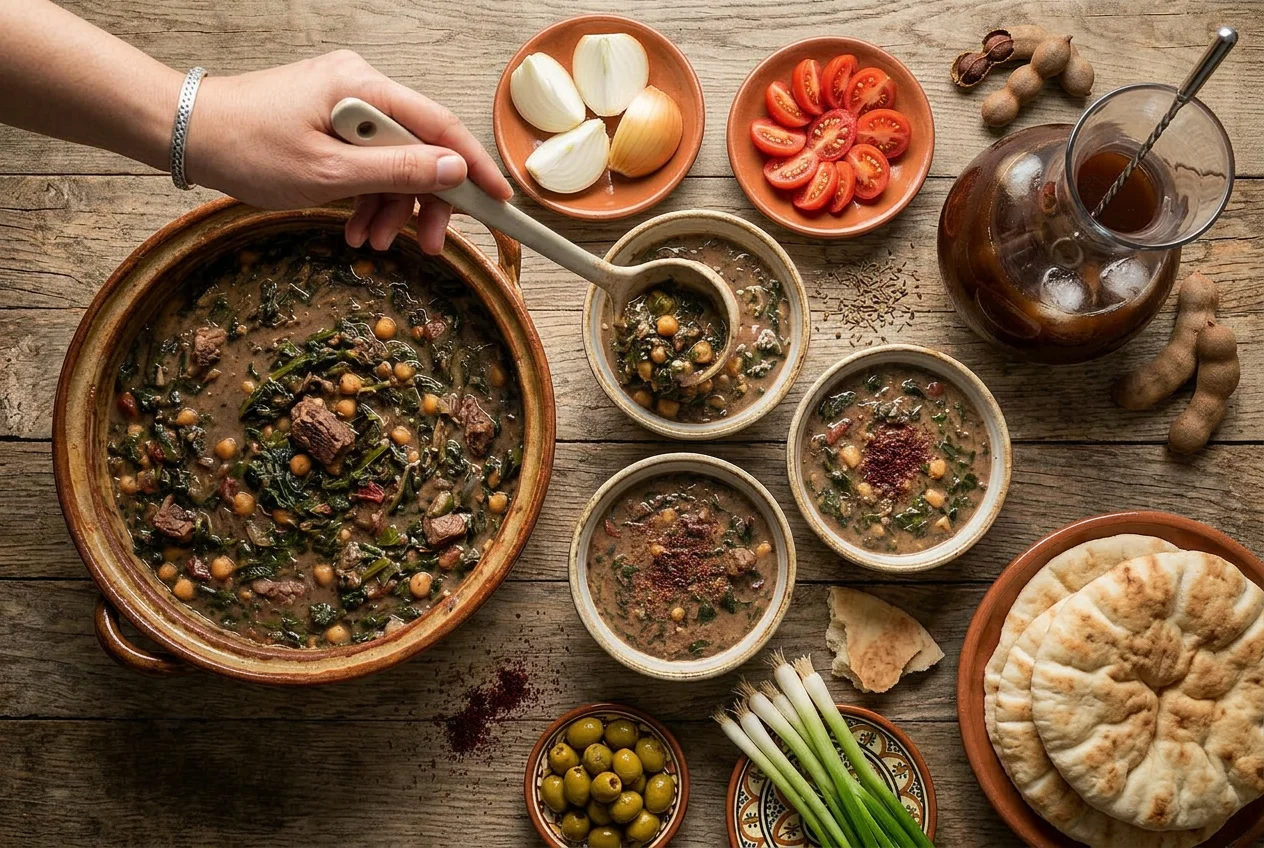
The Soul of Gaza
If there is one dish that belongs to Gaza — and Gaza alone — it is sumagiyya. Not because it cannot be made elsewhere, but because nowhere else has it become so completely woven into the rhythm of communal life. It appears at Eid celebrations, at Christmas tables, and at funerals. It is the dish that says: you matter enough for this.
Sumagiyya is not a dish that impresses on sight. It is dark and earthy, not particularly colorful. But one taste explains everything — the deep tang of sumac, the richness of tahini, the warmth of lamb, the softness of chard — all of it pulling together into something that is more than the sum of its parts. It is a dish that rewards patience and punishes shortcuts.
Traditionally made in large quantities — enough to feed family, neighbors, and anyone who comes to the door — sumagiyya is an expression of Gazan hospitality at its most generous. It is never a small-batch recipe. It is made to overflow.
“Sumagiyya is packed not only with flavor but with character — like the people of Gaza themselves.”
About Sumagiyya
- 🌿 What it is: A slow-braised stew of lamb, Swiss chard, and chickpeas in a thick, tangy sumac broth finished with tahini.
- 🏙️ Where it’s from: Gaza, Palestine. Considered by many to be the defining dish of Gazan cuisine and culture.
- 📖 Historical record: The recipe appears in Kitab Al-Tabikh, a 13th-century Arabic cookbook — making it one of the oldest documented Palestinian dishes.
- 🕌 When it’s made: Eid al-Fitr, Eid al-Adha, Christmas, funerals, and any occasion calling for collective nourishment.
- 🫙 The key ingredient: Sumac — one full cup, soaked overnight or boiled to extract a deeply tangy, crimson broth that forms the backbone of the stew.
The Story
Sumagiyya does not look the way it tastes. The first time many people encounter it, they hesitate — the broth is dark, the color unfamiliar, the appearance humble at best. But Gaza has never been a place that needed to impress on sight. Its food, like its people, carries its depth beneath the surface.
The dish begins with sumac — not a pinch of it, but a full cup, steeped overnight in boiling water until it surrenders everything it has: tartness, depth, and a color somewhere between rust and burgundy. That liquid becomes the broth. The lamb is browned and braised. The chard is added until it wilts into the pot. The chickpeas hold their shape. And then, at the end, tahini — stirred in slowly, thickening everything into something rich and complete.
About the Sumac Broth
The sumac must be soaked or boiled first to extract its flavor before anything else happens. Soak one cup in three cups of boiling water overnight, or simmer for ten minutes and let it cool. Then strain the liquid through a fine sieve, pressing the berries to extract every last bit of tart, tannic juice. That strained liquid is what gives sumagiyya its identity.
Sumagiyya is never a small-batch recipe. It is made to overflow — cooked in abundance for anyone within reach of the door.
The spices in sumagiyya are particular: allspice berries, cardamom pods, cinnamon stick, dill seed, coriander — some ground, some left whole to perfume the broth. There is a specific Gazan technique of mashing salt, red pepper, coriander, dill, and garlic together with a mortar and pestle before adding them to the pot. This is not optional. It is the step that ties everything together.
Flour is whisked into the sumac broth before it ever meets heat — this is what keeps the stew from splitting and gives it its characteristic body. Tahini goes in last, stirred constantly as the pot thickens. The result should be somewhere between a stew and a braise: substantial, deeply flavored, poured into bowls and served alongside warm pita bread. It is, without ceremony, one of the great dishes of the Arab world.
How to Make It
Prepare the sumac broth
The night before, soak one cup of sumac in three cups of boiling hot water. Let it steep overnight. Alternatively, simmer the sumac in water for 10 minutes, then allow it to cool completely to room temperature. Strain the liquid through a fine sieve, pressing the berries firmly to extract maximum flavor. Reserve this liquid — it is the foundation of the dish.
Grind the spice paste
Using a mortar and pestle, grind together the salt, crushed red pepper, coriander, and dill seeds until coarse. Add the crushed garlic — and fresh chili if using — and continue grinding until everything is thoroughly combined into a rough paste. This spice base is added to the pot later and carries much of the dish's character.
Brown the lamb and onions
In a large, heavy-bottomed pot, heat the olive oil over medium-high heat. Add the cubed lamb and chopped onions and sauté together until the lamb is lightly browned on all sides — not fully cooked, just colored. This builds the base flavor of the stew.
Braise the lamb
Add enough water to cover the meat and onions, then bring to a boil. Use a slotted spoon to skim and discard the frothy impurities that rise to the surface. Stir in the allspice berries, cardamom pods, cinnamon stick, and bay leaves. Reduce the heat to low, cover, and cook until the lamb is fully tender and cooked through but still holding its shape — not falling apart. Drain the broth and reserve it.
Wilt the chard
Add the chopped Swiss chard directly to the pot with the cooked meat. Stir over medium heat until the chard is fully wilted and softened. It will reduce dramatically in volume — this is expected.
Build the stew
In a deep pot, whisk together the flour and the reserved sumac broth until completely smooth with no lumps. Add the cooked lamb and wilted chard, the spice paste, the remaining whole spices, salt, chili powder, and the drained chickpeas. Bring to a boil over medium-high heat, stirring constantly as the mixture begins to thicken.
Finish with tahini
Reduce the heat to medium and continue stirring for 10 minutes as the stew thickens. Add the tahini and sesame oil, stirring constantly for another 3 to 4 minutes. Remove from heat. The stew should be thick, glossy, and deeply savory — pourable into bowls but substantial enough to hold its shape briefly.
Serve
Ladle into individual bowls. Serve immediately with warm pita bread for scooping. If desired, dust lightly with a pinch of sumac over each bowl just before serving. This is a dish that belongs on a shared table.