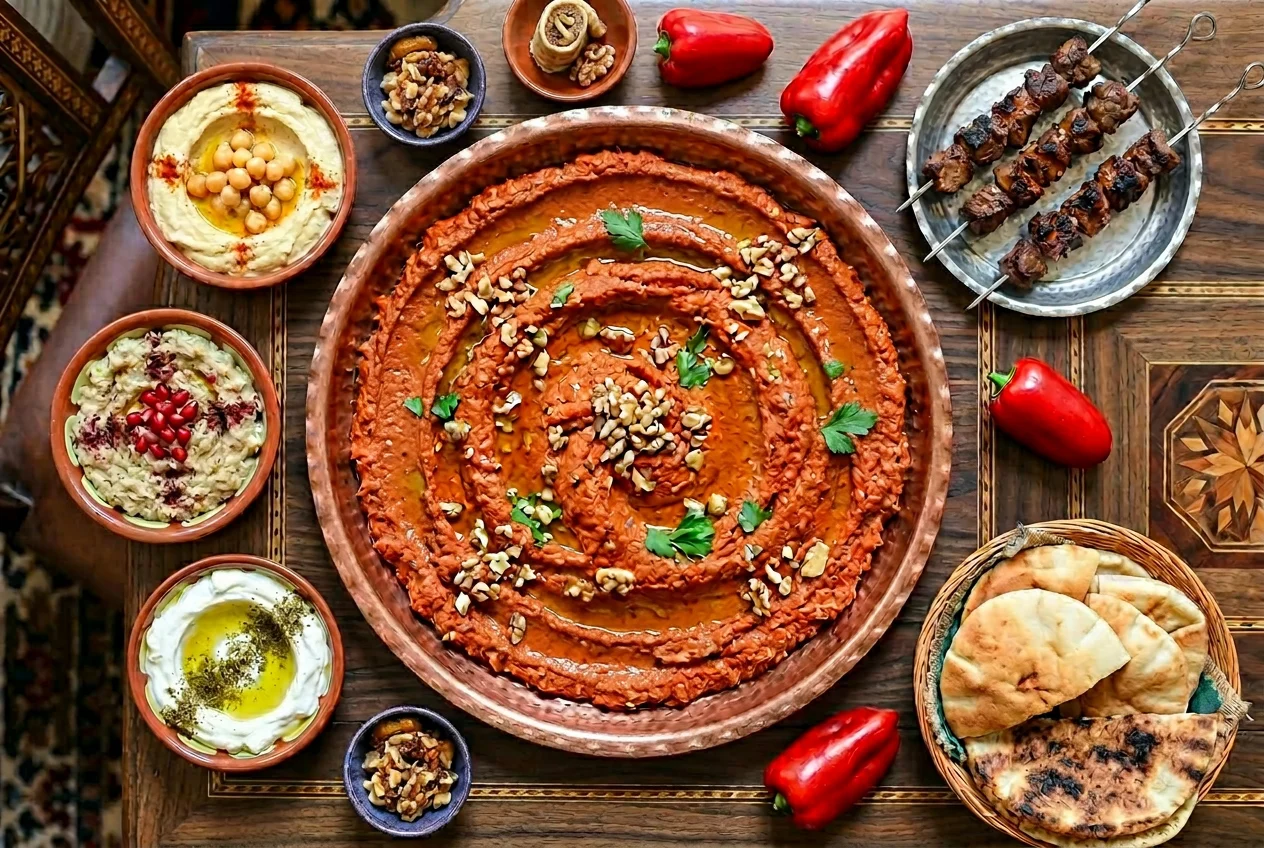
From Aleppo to Every Mezze Table
There’s an old Arabic proverb: generosity comes from what is already at hand. That spirit lives at the heart of every Middle Eastern kitchen, where even the simplest ingredients are treated with care and gratitude. Muhammara may be the purest expression of that tradition in dip form — peppers, walnuts, a few pantry staples — transformed into something that stops conversation at the table.
Its name comes from the Arabic word for “reddened,” a nod to the deep color defined by the peppers at its base. Though Muhammara originated in Aleppo, it gradually spread throughout the Levant, becoming a cherished part of the mezze table in Syria, Lebanon, Palestine, Jordan, and westward to Turkey, where it was adopted and renamed Ajuka.
With a history stretching back centuries, muhammara remains one of the region’s most enduring heritage dishes. For hundreds of years, until the twentieth century, the lands of the Levant were always ruled together under one empire or another. They are separated today by artificial boundaries, but united by language, customs, and culinary traditions that no border has managed to divide.
“A simple combination of humble ingredients transformed into something unforgettable — and a reminder that the best things on the table often begin with whatever is already at hand.”
About Muhammara
- 🌶️ What it is: A rich, smoky dip of roasted red peppers, walnuts, breadcrumbs, and pomegranate molasses — served at room temperature as part of a mezze spread.
- 🏛️ Where it’s from: Aleppo, Syria — one of the oldest continuously inhabited cities in the world and a historic center of Levantine cuisine.
- 🗺️ How far it traveled: From Aleppo across Syria, Lebanon, Palestine, Jordan, and into western Turkey, where it is known as Ajuka.
- 🫙 The key flavor: Pomegranate molasses — its tartness balances the sweetness of the roasted peppers and the richness of the walnuts.
- 🌿 The traditional pepper: Aleppo peppers — mildly spicy, fruity, and slightly oily. Red bell peppers are the practical everyday substitute and work beautifully.
The Story
Muhammara is a beloved Levantine dip with deep roots in the ancient Syrian city of Aleppo, where it has long been part of the region’s rich culinary tradition. Known for its vibrant balance of sweet, tangy, smoky, and gently spicy flavors, it’s traditionally made with Aleppo peppers, walnuts, olive oil, breadcrumbs, and pomegranate molasses — ingredients that come together in a way that feels both rustic and remarkably refined.
Its name comes from the Arabic word for “reddened,” a nod to the dish’s deep red color, defined by the peppers at its base. Though Muhammara originated in Aleppo, it gradually spread throughout the Levant, becoming a cherished part of the mezze table in Syria, Lebanon, Palestine, Jordan, and westward to Turkey, where it was adopted and renamed Ajuka.
They are separated today by artificial boundaries, but united by language, customs, and culinary traditions that no border has managed to divide.
With a history stretching back centuries, muhammara remains one of the region’s most enduring and treasured heritage dishes — a simple combination of humble ingredients transformed into something unforgettable. For hundreds of years, until the twentieth century, the lands of the Levant were always ruled together under one empire or another. They are separated today by artificial boundaries, but united by language, customs, and culinary traditions that no border has managed to divide.
On the Peppers
Traditionally, muhammara is made with Aleppo peppers — a mildly spicy, slightly oily variety with a fruity, almost sun-dried quality that is native to northern Syria. Outside of specialty markets, they can be difficult to find. This recipe uses red bell peppers, which are widely available and roast beautifully. If you can source Aleppo pepper flakes, adding a teaspoon to the blend will bring the flavor noticeably closer to the original.
How to Make It
Roast the peppers
Preheat the oven to 425°F. Brush the red bell peppers lightly with olive oil and place them on a baking sheet. Roast for 30 minutes, turning once halfway through, until the skins are blistered and the peppers are tender throughout.
Steam and peel
Transfer the hot peppers immediately to a bowl and cover tightly with plastic wrap or an airtight lid. Let them steam for 15 minutes — this loosens the skins considerably. Once cooled, peel and discard the skins, cut each pepper in half, and remove the seeds. Slice into strips.
Blend
Place the roasted pepper strips, walnuts, pomegranate molasses, red pepper flakes, cumin, tomato paste, salt, garlic, breadcrumbs, and olive oil into a large food processor. Blend until fully combined and smooth — a little texture from the walnuts is perfectly fine and desirable.
Add lemon juice Optional
Taste the muhammara. If you'd like a brighter, more citrusy edge — common in Lebanese and Palestinian versions — add 1 to 2 tablespoons of fresh lemon juice and pulse briefly to combine. This step is a matter of regional preference and personal taste.
Serve
Transfer to a wide, shallow serving dish. Use the back of a spoon to create a shallow swirl across the surface. Garnish generously with roughly chopped walnuts and a drizzle of good olive oil. Serve at room temperature with warm pita or taboon bread.